

China, with its unique features, including cultural diversity, high population, a high number of schools, universities, and institutes, advanced technological infrastructure, and early adoption of OER since 2003, provides an interesting case study of OER adoption in Asia. China started supporting the use of OER from a rather early stage, following the MIT OpenCourseWare Conference in Beijing in 2003, and from then on, different stakeholders, namely the government, associations, and universities, have been involved with facilitating OER and OEP adoption through the launching of several policies and initiatives.
According to its “China Online Education Market Overview 2020”, published by China Internet Watch [1], part of Incitez Pte. Ltd., a digital consulting company based in Singapore, “the number of online education users in China skyrocketed in 2020 and reached 380.6 million as of June 30, accounting for 40.5% of internet users. Mobile online education users rose sharply and exceeded 400 million in 2020. China’s online education is estimated to be a 400.38 billion yuan (US$58.51 billion) market in 2020, with a growth rate of over 24%.”[2]
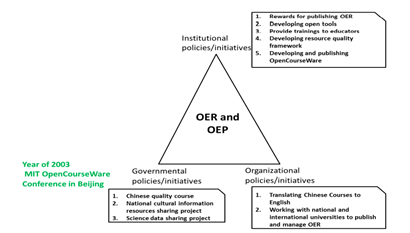
In China, the adoption of OER and OEP is mainly based on the following three levels, that is, governmental, organizational, and institutional initiatives. [3, 4, 6]
- Governmental level: Chinese government has launched three projects, the Chinese Quality Course (CQC), funded by the Chinese Ministry of Education, the National Cultural Information Resources Sharing Project (NCIRSP), funded by the Chinese Ministry of Culture and Finance, and the Science Data Sharing Project (SDSP), funded by the Chinese Ministry of Science and Technology.
- Organizational level, China Open Resources for Education (CORE) is a non-profit organization established in November 2003 following an MIT OpenCourseWare conference in Beijing and that has been involved in more than twenty projects related to OER adoption and sharing in China and abroad [2].
- Institutional level, China Central Radio and Television University (CRTVU), under the direct administration of the Ministry of Education of China, has been pioneering the adoption of OER in China by publishing several open courses within the CQC projects. Additionally, the Open University of Hong Kong (OUHK) and Open University of China (OUC) has developed a generic framework to address quality assurance. Furthermore, several Chinese universities, such as Tsinghua and Shanghai Jiaotong Universities, have taken the initiative to build their own local Massive Open Educational Resources Courses (MOOCs) platforms such as “Xuetang online” and “CNMOOC”. (However, a fact that cannot be ignored is in many cases the content of MOOCs is not released with an open license.)
Figure 1 summarizes the above-presented initiatives and policies in China.
Open Educational Practices (OEP) implemented in China mainly fall into three categories. [3]
- OpenCourseWare. Chinese Ministry of Education reported that during the five-year project of CQC from 2003, 1727 national-level quality courses were published online. By the end of 2010, another 2053 national-level quality courses were produced and, altogether, more than 12,000 provincial-level quality courses and over one million institutional-level quality courses had been published. 12 Chinese universities are providing over 154 MOOCs on international platforms, such as edX and Coursera, while 112 Chinese universities are providing over 593 MOOCs on national platforms, such as XUETANG and iCourse. Currently, 762 universities joined the website Chinese Universities MOOC (icourse163.org).
- Open tools. In addition to using international open platforms and tools such as Moodle or edX, China has developed their own open platforms/tools. For instance, the microblogging platform Sina Weibo, which is similar to Twitter, has been used in China as a platform to support collaborative work within Chinese MOOCs. Other popular open platforms for MOOCs that have been developed and used by Chinese universities include XuetangX, CNMOOC, and iCourse163. [11]
- Open teaching. Several universities in China, such as Peking and Tsinghua Universities, have started providing MOOCs for students and qualify as the most active universities in adopting MOOCS outside of North America. In these MOOCs, students have to go through various interactive materials and assignments to learn, which is in line with the main international developments.
Figure 2 summarizes several challenges that have hindered the adoption of OER and OEP in China:

The challenge related to copyright is that most individuals do not want to publish their OER due to the fear of copyright infringements, it is found that most people and institutions publish their OER without an open license which defines how others should use these resources. Additionally, it is found that most individuals are not aware of Creative Commons (CC) licenses and therefore do not use them. Similarly, intellectual property has been found to be a problem in providing MOOCs. [3]
References:
- China Internet Watch – China Digital Trends & Insights
- China Online Education Market Overview 2020 – China Internet Watch
- Tlili, A, Huang, Chang, et. al. (2019) Open Educational Resources and Practices in China: A Systematic Literature Review (mdpi.com). Sustainability.
- Wang Chunyan and Zhao Guodong (2012). Open Educational Resources in the People’s Republic of China: Achievements, Challenges and Prospects for Development, on UNESCO Institute for Information Technologies in Education.
- https://enacademic.com/dic.nsf/enwiki/10198964
- http://freecourseware.ouhk.edu.hk
- 国家教育资源公共服务平台 (eduyun.cn)
- 中国教育在线-推动教育前进的力量 (eol.cn)
- 开放教育-CEPSP-中国教育在线公共服务平台 (eol.cn)
- The Open University of China (ouchn.edu.cn)
- 中国高校计算机教育MOOC联盟_中国大学MOOC(慕课) (icourse163.org)
- 上海外国语大学与英国慕课平台FutureLearn深化战略合作 (shisu.edu.cn)
- SISU┆上海外国语大学国际慕课 Intercultural Communication 第七轮即将上线!_课程 (sohu.com)

 Design Just For You