
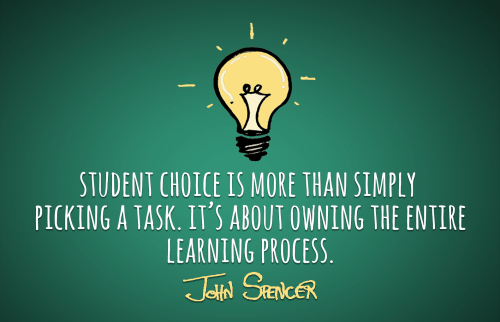
For Discussion Facilitation Project, we have designed on Active Participation and Student Choices. And we received positive feedback from the participants and instructor.
This discussion aims to find out how to activate class participation by giving students the power of choice. Our goals in this project are to encourage deeper thinking over the following questions:
- Why give students the power of choice?
- What strategies can be used to encourage students to take ownership in designing and organizing the class?
- How can students’ choices enhance the learning outcome?
Step 1: Starting with the UDL Guideline Graphic Organizer, especially under “Engagement” about “Optimize individual choice and autonomy”, we request learners to explore any 3 of the resources in the following choice board below, from any category:
| Articles | Who Owns the Learning in Your Classroom? (A teacher’s real story on his journey to empower his students to take ownership through their own choice. ) | Differentiating by Offering Choices (Ways to offer differentiated instruction to meet students’ individual needs and help them grown their highest potential.) | Google 20% Time – Employee Choice (Google encourages its employees to devote 20% of their time to side projects in which they can use their choices and strengths for innovation.) |
| Videos | Personalized Learning: Enabling Student Voice and Choice Through Projects (How did Nashville Big Picture High School use personalized learning projects to enable students’ voice and choices and build students engagement?) | 10 Ways to Empower Students with Choice (Let students choose their learning strategies, materials/resources, topics, formats, etc., but teachers still need to make decisions.) | Giving Students Power and Control (The author of the book Learning to Choose, Choosing to Learn discusses what occurs when students have their own choices.) |
| Podcasts | Genius Hour (10:24-15:05)(AJ Juliani introduces how he started “20% Project” like Google as “Genius Hour”) | Student Choice Menus (8:05-19:21)(Eric Boyer, Assistant Professor of St. Martin’s University, brings theories to practice in providing a menu of choices and motivational engagement to his class.) | Project Based Learning (20:20-28:20)(Project and Problem based learning is getting students involved and connected with the subjects of learning and reduce academic stress.) |
Step 2: A discussion is facilitated about the power of student choice from 3 perspectives
- The power of choice on what to learn: syllabus, class content, resources
- The power of choice on how to learn: activities, tools, media formats
- The power of choice on how to be assessed: rubric, grades, format
In the discussion, the learners are expected to talk about a time where they gave (or will give) students choice, what category the example falls under? and what the results were? The learners are encouraged to go outside of the classroom if they are working in a professor and see how they have given choice in the workplace.
The following questions are provided as guidance for a reflection on the power (or drawbacks) of student choice.
- What are some anticipated drawbacks with this strategy of giving students the power of choice?
- Do the pros of giving students choice outweigh the cons?
- Who should be the one making rules? The one making the final decisions?
- What if there is disagreement or conflict among students?
- What is the instructor’s role? Facilitator, Mediator, Policy-maker, Decision-maker, Final grader, Other?
- How much power is considered a proper amount for students to make choices?
- How do we make all students in the class contribute equally in the process, instead of some students dominating?
- How do we turn the learning outcome into letter/numeral grades?
- How can this strategy be differently conducted based on different age/grade levels?
Various options of formats are suggested to use when presenting the reflection of ideas:
- Video
- Audio
- PowerPoint
- Wordle
- Sketch
- Anything else! The sky’s the limit!
Step 3: After discussions and reflections are collected, a summary is provided:
In general, it is widely agreed that giving students the power of choices is an attractive and promising strategy to take. Its pros outweighs the cons, if the strategy is well designed and implemented.
Drawbacks:
- It might be overwhelming or frustrating for students, esp. those who are unprepared, at the beginning stage;
- Need a lot more work on keeping balance among the choices, balance among students at different levels in the same class (background, culture, capability, motivation, study skills, etc.), balance in students’ learning outcome, balance in assessment;
- On one hand, students might want to try out something new without realizing how much work it might be for them; on the other hand, students might be hesitating to challenge themselves, or explore something new, because of their concerns over competitiveness, success/failure, or final grade;
- It’s easier to give students choices on “how to learn” and “what to learn”, than on “how to assess”
- There might be a lot more work on teacher’s side because of the variety and diversity of students’ choices
Suggestions:
What is needed before giving the students the power of choice?
- Build a trusting relationship with students and have open discussion with students before making any decision;
- Teacher needs to do a lot prep work in planning and preparation;
- General rules/norms and students’ agreements to follow the rules;
- Sufficient explanation about why students will be given the power of choice and guidance and training provided to students before giving them the power;
- Regular checking from the teacher to make sure every student is contributing to and benefiting from this learning process;
- Good design on Choice Board, Rubrics, etc.
Stages of using the strategy:
Stage 1: Teacher’s planning and preparation
Stage 2: Discussion among teachers and students for a good awareness to this strategy and a trusting relationship
Stage 3: Teacher-guided training on making choices
Stage 4: Teacher-facilitated students’ choices on what to learn, how to learn and how to assess
Stage 5: Students’ own choices with teachers’ checking and support on a regular basis
Stage 6: Reflection and Self-reflection
Some additional resources are provided for anyone who wants to dive deeper (You may need to “register for free” to access some of the materials.)
- Opinion: “When Students Design the Assessment, Everyone Wins” (Ed Week)
- “Learning Menus” Empower Student to Tailor Curriculum” (Education Week)
- Video: “Unit Menus: The Power of Student Choices” (YouTube, 27:12)
- Video: “Learning Menus Giving Students Choices & Independence” (Teaching Channel)
- “How to Give Students More Control over Their Learning” (Education Week)
- News: Faculty Lunch: Supporting Student-Directed Learning (BOK Center for Teaching and Learning, Harvard University)
- News: Students Supporting Student Learning (Links to an external site.)(BOK Center for Teaching and Learning, Harvard University)
- Podcast: Imagine (a world of assessment without tests) The EdTech Podcast
- Opinion: “When Students Design the Assessment, Everyone Wins” (Ed Week)
- Google Book: Mike Anderson (2016) Learning to Choose, Choosing to Learn
- “Developing responsible and autonomous learners: A key to motivating students.” by Barbara McCombs
Step 4: Peer Feedback and Instructor’s Comments (Google Doc)
 Design Just For You